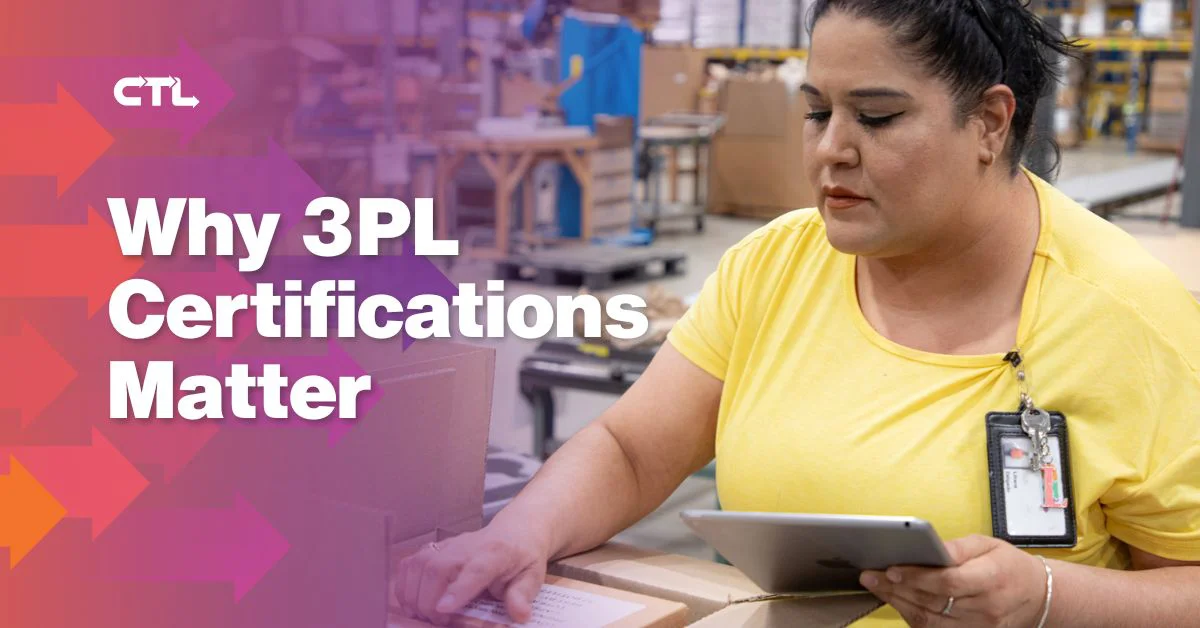
Why 3PL Certifications Actually Matter (and How to Evaluate Them)
- Josh Miller
Choosing a 3PL is not just a cost decision. It is a risk decision.
If something goes wrong in your supply chain, it is your brand that takes the hit. A missed shipment, a contamination issue, or a failed audit does not stay inside a warehouse. It shows up with your customers, your retailers, and your revenue.
That is where certifications come in.
But most brands misunderstand what certifications actually tell you, and just as importantly, what they do not.
This article breaks down the certifications that matter, how to think about them as a buyer, and how CTL applies them in practice.
Certifications Do Not Guarantee Performance but Lack of Them Creates Risk
A certified 3PL is not automatically a great partner.
But a 3PL without the right certifications is introducing avoidable risk into your business.
The right way to think about certifications is that they establish a baseline level of discipline and compliance. They provide third party validation of processes. They also reduce the likelihood of major failure events such as recalls or audit failures.
What they do not do is guarantee daily execution, replace strong operational leadership, or eliminate the need for oversight.
The better question to ask is not simply whether a provider is certified. It is which certifications matter for your business and how those certifications show up in daily operations.
Food Safety and GFSI and BRC Certifications
If you are in food, beverage, or ingestible products, this is foundational.
The Global Food Safety Initiative sets the global benchmark for food safety systems. BRC Storage and Distribution is one of the recognized standards under GFSI and is designed specifically for logistics environments.
In practice, this means defined food safety procedures, traceability across the supply chain, and regular third party audits that evaluate facilities, processes, and training.
When evaluating a 3PL, you should understand whether certifications apply to the specific facility you will use, how often audits occur, and how issues are handled when they arise.
CTL maintains BRC certification within its food grade operations. This means processes, training, and facility standards are built around ongoing audit readiness. For clients, this reduces exposure to compliance issues and lowers the risk of disruption tied to food safety concerns.
FDA Registration and Real Compliance
Every warehouse handling food in the United States must be registered with the FDA. That is the starting point.
What matters more is how a 3PL operates under the Food Safety Modernization Act.
A well run operation should have documented food safety plans, hazard analysis, preventive controls, and defined procedures for temperature management and sanitation. It should also have clear recall readiness and traceability.
Many 3PLs meet the registration requirement but operate inconsistently in practice.
CTL’s FDA registered facilities operate under structured food safety plans tied to preventive controls. This creates consistency as volume grows and operations become more complex, helping clients avoid gaps that can lead to risk.
ISO 9001 and Process Discipline
While food certifications focus on product safety, ISO 9001 focuses on how work gets done.
In a warehouse environment, that directly impacts receiving accuracy, inventory control, fulfillment consistency, and issue resolution.
ISO systems require documented procedures, accountability for deviations, and a framework for continuous improvement.
When evaluating a provider, it is important to understand whether processes are consistent across shifts and teams, how errors are tracked, and whether improvements are systematic or reactive.
CTL applies ISO aligned process discipline across core operations. This creates predictable outcomes for clients, especially in environments where volume fluctuates or new programs are introduced.
Ethical and Responsible Operations with SMETA Pillar 4
For today’s brands, choosing a logistics partner is also a choice about the values embedded in your supply chain. CTL’s SMETA Pillar 4 certification gives our clients confidence that their products are handled within a facility that meets globally recognized standards for labor practices, health and safety, environmental responsibility, and business ethics. This certification isn’t just an internal achievement — it’s a direct benefit to our customers. It ensures that your brand is supported by a 3PL whose operations have been independently audited for integrity, transparency, and responsible business conduct. By partnering with a SMETA‑certified provider, you strengthen your own ESG commitments, reduce reputational risk, and demonstrate to your consumers and stakeholders that your supply chain reflects the same values your brand stands for.
Sustainability and Practical Application
Sustainability is increasingly important, but the real question for most brands is whether a 3PL can implement sustainable practices in a repeatable way.
Certifications such as those tied to responsible sourcing of packaging materials can support brand positioning, but only if they are operationalized.
A practical evaluation should focus on whether a 3PL can source and deploy certified materials consistently and at scale.
CTL supports clients that require sustainable packaging as part of their fulfillment strategy. The value is not just access to certified materials, but the ability to integrate them into ongoing operations without introducing complexity.
WBENC and Supplier Diversity Requirements
WBENC certification reflects that a business is woman owned and operated. Its relevance depends on the type of organization you are running.
For mid-market and direct to consumer brands, this may not be a primary driver of the decision.
For companies serving large retailers or enterprise customers, supplier diversity requirements may make this an important consideration.
CTL’s WBENC certification allows clients to meet supplier diversity objectives without adding procurement friction, which can be meaningful in enterprise environments.
How to Evaluate Certifications in Practice
Certifications alone do not tell the full story. The key is understanding how they are applied.
Before selecting a 3PL, it is worth asking direct questions about which certifications apply to your specific facility, the outcome of recent audits, how recalls are handled, and how operations scale as volume increases.
Most providers will have certifications on paper. Fewer will have them embedded into daily execution.
Where CTL Fits
CTL is not differentiated simply because it holds certifications. Most credible 3PLs do.
The difference is in how those certifications are integrated into operations.
CTL operates facilities aligned with BRC standards for food grade programs, maintains FDA registered environments with structured food safety plans, and applies process discipline consistent with ISO principles. It also supports clients with sustainability and supplier diversity requirements where those are relevant.
With facilities in Elmhurst and Elk Grove Village, CTL provides a central United States footprint that supports both compliance and execution.
Bottom Line
Certifications should not be the only factor in choosing a 3PL, but they should shape your shortlist.
The goal is not to find the provider with the most certifications. It is to find a partner where certifications are relevant to your business, embedded in daily operations, and supported by consistent execution.
That is what reduces risk and protects your brand.