What Causes Fulfillment Breakdowns for Growing Brands?
- CTL
Growth is usually a good problem until fulfillment begins putting the customer experience and profitability at risk.
As orders increase, sales channels expand, SKU counts rise, and customer requirements become more demanding, fulfillment operations must manage significantly mor complexity. Processes that worked during an earlier stage of growth can become strained, creating inventory discrepancies, shipping delays, warehouse inefficiencies, retailer chargebacks, and rising operating costs.
These issues rarely originate from one isolated mistake. Fulfillment breakdowns typically occur when inventory management, warehouse processes, technology systems, transportation strategy, and compliance requirements do not scale alongside the business.
For growing brands, recognizing these risks early is an important step toward building an operation that supports growth rather than constrain it. Whether fulfillment is managed internally or through a third-party logistics provider, reliable execution depends on disciplined processes, connected systems, accurate information, and clear operational accountability.
Key Takeaways: What Causes Fulfillment Breakdowns?
- Fulfillment breakdowns usually develop across five interconnected areas: inventory integrity, warehouse execution, technology integration, transportation strategy, and retail compliance.
- Operational issues that appear manageable at lower volumes often become more costly and disruptive as order volume, SKU count, sales channels, and service requirements increase.
- Inventory discrepancies affect more than product availability. They can lead to overselling, backorders, fulfillment delays, customer-service contacts, and a loss of confidence in operational reporting.
- Warehouse processes must be documented, measurable, and repeatable. Operations that rely heavily on individual knowledge or manual workarounds become more difficult to manage as complexity increases.
- Technology should connect orders, inventory, fulfillment, and shipment information while reducing duplicate data entry and manual intervention.
- Shipping cost and service performance depend on more than carrier rates. Product characteristics, customer concentration, fulfillment location, delivery commitments, and inventory placement all affect the outcome.
- Brands should evaluate a fulfillment partner based on operational discipline, inventory controls, implementation capabilities, technology connectivity, communication, and scalability, not pick-and-pack pricing alone.
Why Do Fulfillment Breakdowns Occur During Growth?
Fulfillment breakdowns rarely result from a single operational failure. More often, they emerge when processes designed for one stage of growth are expected to support a larger and more complex business.
As a brand grows, it may add products, customers, marketplaces, retailers, delivery requirements, promotional campaigns, and value-added services. Each change creates additional operational requirements.
An operation may be managing:
- More orders and order lines
- A larger or more complex SKU catalog
- Multiple e-commerce marketplaces
- Wholesale and retail orders
- Retailer-specific routing and labeling requirements
- Kitting, assembly, or customized pack-outs
- Seasonal or promotional demand spikes
- More returns and customer-service exceptions
- Additional technology systems and data connections
Order volume is only one measure of fulfillment complexity. A business shipping a high volume of simple, single-line orders may be easier to support than a business shipping fewer orders that involve large SKU counts, lot controls, retail compliance, kitting, assembly, or customized packaging.
For this reason, fulfillment capacity should not be evaluated only by the number of orders an operation can process. Brands also need to consider the complexity of the work, the reliability of their systems, the consistency of their processes, and the operation’s ability to manage exceptions.
Many brands invest in sales and marketing before making comparable investments in fulfillment infrastructure. The resulting imbalance creates operational risk. Orders continue to increase, but the systems, processes, space, labor, and management structure supporting those orders may not keep pace.
Over time, small issues begin to compound. Inventory adjustments increase, manual workarounds become routine, shipping exceptions require more attention, and employees spend increasing amounts of time solving problems rather than improving the operation.
The Five Areas Where Fulfillment Commonly Breaks Down
Most fulfillment breakdowns can be traced to five interconnected areas:
- Inventory integrity
- Warehouse execution
- Technology integration
- Transportation and network strategy
- Retail and channel compliance
A weakness in one area often creates problems in several others.
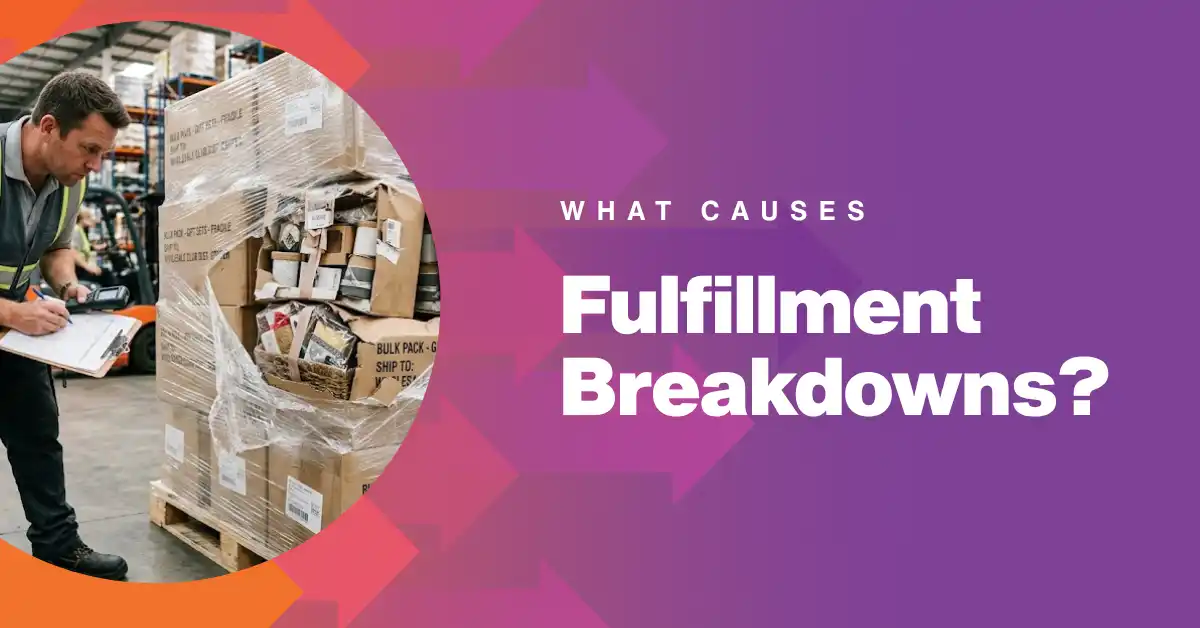
For example, an inaccurate receiving transaction can create an inventory discrepancy. That discrepancy can lead to an order being accepted for product that is not actually available. The warehouse must then research the issue, customer service may need to contact the customer, and the business may incur additional cost to expedite or replace the order.
The immediate problem appears to be inventory accuracy, but the financial and customer impact extends across the organization.
How Do Inventory Problems Lead to Fulfillment Failures?
Inventory integrity is one of the most important foundations of fulfillment execution. When system inventory does not match physical inventory, every downstream process becomes less reliable.
Orders may be accepted for products that cannot be located or are no longer available. Inventory may be allocated to one sales channel even though it has already been committed to another. Employees may spend time searching for products, correcting records, or researching unexplained variances.
The consequences can include:
- Overselling
- Backorders
- Split or incomplete shipments
- Order cancellations
- Lost sales
- Expedited freight
- Customer-service contacts
- Inventory write-offs
- Retail shortages or chargebacks
- Reduced confidence in operational and financial reporting
Inventory discrepancies often accumulate gradually. A receiving error, incorrect unit of measure, misplaced product, unrecorded damage, inaccurate adjustment, or missed transaction may initially appear insignificant. As order volume and inventory movement increase, however, the discrepancy becomes more difficult to isolate and more likely to affect customers.
Manual corrections can temporarily hide the symptoms without addressing the underlying cause. When adjustments become routine, the operation may lose the ability to distinguish isolated errors from recurring process failures.
Example: How One Inventory Issue Creates Multiple Problems
Consider a brand that serves e-commerce customers and retail accounts from a shared inventory pool.
If inventory updates are delayed or retail allocations are managed manually, the e-commerce platform may show product as available even though it has already been committed to a retailer. Customers continue placing orders, but the warehouse cannot fulfill them.
The result is more than an inventory discrepancy. The brand may experience canceled orders, customer-service contacts, expedited inbound freight, retailer shortages, and a loss of confidence in the underlying data.
What began as a system or process issue becomes a customer, operational, and financial problem.
What Systems and Processes Help Protect Inventory Accuracy?
Inventory accuracy requires consistent transaction discipline throughout the product lifecycle. Every receipt, movement, adjustment, pick, shipment, return, and disposition affects the reliability of the inventory record.
Effective inventory-control practices may include:
- Barcode-based receiving and movement
- Defined receiving and putaway processes
- System-directed inventory locations
- Lot, expiration, serial, or date controls when required
- Routine cycle-count programs
- Inventory adjustment controls
- Root-cause review of recurring variances
- Clear procedures for damaged, returned, or quarantined products
- Reporting that identifies discrepancies before they affect customers
Cycle counting is most effective when it is used as a control process, not simply as a recurring correction exercise. The objective is not only to identify that inventory is wrong. It is to determine why the discrepancy occurred and prevent the same issue from recurring.
Connected inventory and order-management systems also improve visibility across sales channels. When inventory information moves reliably between the warehouse, ordering platforms, marketplaces, and customer systems, brands can make more dependable decisions about product availability and order commitments.
CTL supports customers with technology integrations designed to connect fulfillment activity with customer ordering and inventory systems. The appropriate integration approach depends on the customer’s platforms, transaction requirements, business rules, and reporting needs.
How Do Warehouse Operations Contribute to Fulfillment Breakdowns?
Warehouse operations determine how efficiently and accurately products move from receipt through storage, picking, packing, and shipment.
Processes that work at lower volumes may become less dependable as volume and complexity increase, particularly when they rely on informal procedures, manual workarounds, or the knowledge of individual employees.
Common warehouse breakdown points include:
- Receiving delays that prevent product from becoming available
- Products being stored in incorrect or inefficient locations
- Pick accuracy declining as order volume or SKU complexity increases
- Packing requirements varying without clear work instructions
- Order exceptions interrupting normal workflow
- Quality checks occurring inconsistently
- Shipping errors increasing during peak periods
- Labor cost increasing without comparable throughput improvement
- Space becoming congested as inventory and activity increase
- Key processes depending on one or two experienced employees
Demand surges, seasonal peaks, product launches, and promotions often expose these weaknesses because the operation must perform at maximum capacity with limited tolerance for error.
The underlying goal should not be to push the operation harder during peak periods. It should be to build processes that remain reliable when volume, labor requirements, and operational pressure increase.
What Warehouse Practices Support Scalable Fulfillment?
Scalable warehouse operations depend on repeatable processes that can be taught, measured, and consistently executed.
Important practices include:
Documented Workflows
Receiving, putaway, replenishment, picking, packing, shipping, returns, and inventory adjustments should follow clearly defined processes. Documentation helps reduce dependence on individual knowledge and creates a consistent basis for training and accountability.
Strategic Slotting
High-velocity products should be positioned to reduce unnecessary movement and travel time. Slotting decisions should also consider product size, weight, compatibility, handling requirements, and items frequently ordered together.
Standardized Pick and Pack Processes
Picking methods, pack-out instructions, scanning requirements, and quality controls should align with the characteristics of the customer’s orders and products. A single process may not be appropriate for every order profile.
Quality-Control Checkpoints
Quality should be built into the workflow rather than inspected only at the end. The right checkpoints depend on the product, order type, channel, and consequences of an error.
Capacity and Peak Planning
Order forecasts must be translated into expected labor, space, equipment, materials, and carrier requirements. The plan should also identify how the operation will respond when actual demand differs from the forecast.
Root-Cause Management
Recurring errors should be investigated and addressed systematically. Repeatedly correcting the same issue without changing the underlying process increases cost and allows avoidable problems to continue.
CTL’s fulfillment and value-added services include capabilities such as kitting and assembly that can be incorporated into a customer’s broader fulfillment program. These services should be designed around documented requirements, expected volumes, quality standards, and the customer’s service expectations.
Why Does Technology Integration Matter for Growing Brands?
Growing brands often accumulate technology over time. One system may manage e-commerce orders, another may track inventory, another may produce shipping labels, and additional systems may support marketplaces, retailers, accounting, or customer service.
Each system may perform its individual function well. Problems occur when information does not move reliably between them.
Disconnected systems can result in:
- Duplicate data entry
- Delayed inventory updates
- Incorrect order information
- Manual file uploads
- Missed or duplicated orders
- Incomplete shipment confirmations
- Inconsistent reporting
- Increased dependence on spreadsheets or individual employees
- Decisions based on outdated information
Manual intervention also makes the operation more difficult to scale. A process that requires an employee to download, edit, and upload files may be manageable at lower volumes. As orders and channels increase, however, the same process creates delays, error risk, and an additional point of operational dependence.
Omnichannel fulfillment depends on connected information. Order details, inventory availability, allocations, shipment status, tracking data, and exceptions must move accurately between the systems used by the brand and its fulfillment operation.
What Integration Capabilities Should Brands Evaluate?
The integration conversation should extend beyond whether a fulfillment provider can connect to a particular platform. Brands should understand how the entire transaction flow will operate.
Important questions include:
- How will orders enter the warehouse management system?
- How frequently will information be exchanged?
- How will inventory updates flow back to each sales channel?
- How will order changes, cancellations, and holds be managed?
- How will shipping confirmations and tracking information be returned?
- How will exceptions or failed transactions be identified?
- Who monitors the connection and responds when an issue occurs?
- Which elements are standard, configured, or customized?
- How will the integration be tested before launch?
- What reporting will be available after implementation?
CTL has experience connecting fulfillment operations with platforms and enterprise systems used by its customers. Specific platform, marketplace, EDI, API, middleware, and carrier capabilities should be evaluated during discovery because the appropriate solution depends on the customer’s systems and transaction requirements.
Connecting the systems is only part of the solution. The integration must also reflect the business rules that govern allocations, order priorities, shipping methods, inventory status, cancellations, returns, and exception handling.
What Role Does Shipping Play in Fulfillment Breakdowns?
Shipping represents a significant part of the customer experience and the total cost of fulfillment.
As brands expand geographically, the distance between inventory and customers becomes increasingly important. Longer shipping distances can affect parcel costs, transit times, delivery consistency, and the number of service options available.
The impact may be greater for:
- Heavy products
- Oversized products
- High-volume promotional shipments
- Orders requiring expedited delivery
- Products with low margins relative to shipping cost
- Customers located far from the fulfillment point
Carrier rates are only one part of shipping performance. Product dimensions, weight, packaging, destination, service level, delivery expectations, accessorial charges, and volume profiles all influence the final cost.
Brands should also consider the cost of shipping failures. A delayed, damaged, incorrectly routed, or incomplete order can create reshipment expense, customer-service work, refunds, and loss of customer confidence.
How Does Fulfillment Location Affect Shipping Performance?
Fulfillment location affects transportation cost, delivery speed, inventory positioning, and operational complexity.
A centrally located facility can provide balanced geographic reach from a single inventory pool. CTL’s Chicago-area operations provide access to major transportation infrastructure and support distribution to markets throughout the United States.
However, no location strategy is right for every brand. The appropriate approach depends on:
- Where customers are concentrated
- Required delivery times
- Average order size and weight
- Parcel and freight characteristics
- Inventory carrying costs
- Seasonality
- Inbound transportation
- Retail distribution requirements
- The cost and complexity of splitting inventory
- The service benefit created by an additional location
Adding facilities can reduce shipping distance for some orders, but it also creates additional inventory, system, replenishment, and management requirements. Brands must weigh the transportation benefits against the cost and complexity of maintaining multiple inventory positions.
Warehouse placement should therefore be based on actual order and customer data rather than geography alone.
How Do Retail and Omnichannel Requirements Create Fulfillment Risk?
Brands expanding from direct-to-consumer fulfillment into wholesale or retail distribution face a different set of operating requirements.
Retailers may require compliance with detailed routing guides, appointment procedures, labeling specifications, carton configurations, pallet requirements, documentation standards, and electronic transactions.
Advanced Shipping Notices, Electronic Data Interchange transactions, and retailer-specific routing instructions introduce additional operational dependencies.
Errors can result in:
- Retailer chargebacks
- Deductions
- Delayed receiving
- Rejected freight
- Rework
- Expedited transportation
- Incomplete or disputed deliveries
- Lost time researching claims
- Strained retailer relationships
These issues may not become visible immediately. A shipment can leave the warehouse and appear successful, only for a deduction or compliance penalty to appear later.
A brand entering retail distribution should not assume that the same process used for an e-commerce order will satisfy a retailer’s requirements. Retail execution requires documented procedures, accurate data, properly configured systems, trained employees, and consistent compliance monitoring.
What Retail Compliance Support Should Brands Seek?
A fulfillment partner supporting retail distribution should demonstrate an understanding of retailer-specific operating requirements.
Brands should evaluate whether a potential partner can:
- Review and interpret retailer routing guides
- Manage required EDI transactions
- Produce compliant labels and shipping documents
- Follow routing and appointment instructions
- Support retailer-specific packing and pallet requirements
- Maintain records needed to investigate deductions
- Identify recurring compliance issues
- Adjust processes as retailer requirements change
- Coordinate retail activity with e-commerce fulfillment
Retail compliance should begin during onboarding, not after the first chargeback. The fulfillment partner and customer should identify retailer requirements, define ownership, configure systems, document processes, and test transactions before volume begins.
CTL supports retail and omnichannel programs through established fulfillment, systems integration, and compliance processes. The specific requirements of each retailer and customer program should be reviewed during implementation.
What Are the Hidden Costs of Fulfillment Breakdowns?
The visible cost of a fulfillment error may be a reshipment, refund, or chargeback. The total cost is often much larger.
A fulfillment breakdown can create cost across several functions:
- Warehouse labor used to research and correct the error
- Customer-service time
- Replacement product
- Expedited freight
- Additional packaging materials
- Retail deductions and chargebacks
- Inventory adjustments or write-offs
- Overtime or temporary labor
- Lost sales from inaccurate availability
- Management time spent resolving recurring exceptions
- Reduced customer retention
- Damage to retailer or marketplace relationships
These costs are not always captured in the original fulfillment transaction. They may appear in different departments or financial categories, making the true cost of operational failure difficult to see.
This is why evaluating fulfillment only on pick-and-pack pricing can be misleading. A lower transaction rate does not necessarily create a lower total cost if inventory, service, reporting, and compliance performance are unreliable.
How CTL Helps Brands Avoid Fulfillment Breakdowns
CTL supports growing brands through a combination of warehousing, order fulfillment, retail distribution, technology integration, inventory management, and value-added services. By connecting inventory visibility, operational processes, and customer reporting, CTL helps brands identify potential fulfillment risks before they impact customers. CTL’s experience supporting direct-to-consumer, retail, and omnichannel programs allows customers to scale while maintaining service levels and operational control.
What Distinguishes a Fulfillment Partner That Can Support Growth?
The difference between a warehouse vendor and a fulfillment partner becomes clearer when volume increases, complexity changes, or problems emerge.
A capable fulfillment partner should do more than store inventory and ship orders. The partner should understand the customer’s products, channels, service expectations, systems, growth plans, operating risks, and reporting needs.
The relationship should also include clear accountability. Brands should understand who owns implementation, daily execution, inventory controls, reporting, issue resolution, and continuous improvement.
Price remains an important part of the decision, but it should be evaluated alongside service, accuracy, implementation risk, technology, communication, and the total cost of operational failure.
Questions worth asking when evaluating a 3PL fulfillment partner
Inventory and Reporting
- How is inventory accuracy measured and reported?
- How frequently are cycle counts performed?
- How are inventory adjustments approved and investigated?
- What inventory, order, and shipment information will be available to us?
- How are recurring discrepancies addressed
Warehouse Execution
- How are receiving, picking, packing, and shipping processes documented?
- How is quality measured?
- How are customer-specific work instructions controlled?
- How does the operation manage unusual orders or exceptions?
- How are labor and capacity planned for peak periods?
Technology
- How will our platforms and systems connect?
- Which integrations are standard, configured, or custom?
- How are failed transactions identified and resolved?
- How is the solution tested before implementation?
- Who is responsible for ongoing technical support?
Retail and Channel Compliance
- What experience does the provider have supporting our sales channels?
- How are retailer routing guides and compliance requirements managed?
- How are chargebacks investigated?
- How are changes in customer or retailer requirements communicated and implemented?
Implementation and Account Management
- Who will own implementation?
- What information is required before launch?
- How will inventory be transferred and validated?
- Who will manage the ongoing relationship?
- How are service issues escalated?
- How frequently will performance be reviewed?
Growth and Flexibility
- How will the operation adapt if our volume or order profile changes?
- Can the provider support kitting, assembly, or customized pack-outs?
- How will new products, channels, or retailers be onboarded?
- What happens if actual demand exceeds the forecast?
- How does the provider approach continuous improvement?
When Should a Brand Consider Outsourcing Fulfillment?
There is no single order-volume threshold that determines when a brand should use a 3PL.
The better question is whether fulfillment complexity has begun to exceed the organization’s internal capacity or distract from its core priorities.
Warning signs may include:
- Inventory accuracy is declining
- Orders are shipping late
- Employees rely heavily on spreadsheets or manual processes
- The business is running out of warehouse space
- Peak periods require unsustainable overtime or emergency labor
- Management spends excessive time resolving operational issues
- Retail or marketplace requirements are becoming more complex
- The business needs new technology or integrations
- Shipping costs are increasing without clear visibility into the cause
- Kitting, assembly, labeling, or customized pack-outs are becoming difficult to manage
- Customer growth is being limited by fulfillment capacity
Outsourcing should not be viewed only as a response to operational failure. The strongest transitions are often planned before service declines, allowing the brand and its fulfillment partner to design, test, and implement the new operation deliberately.
Conclusion: Build Fulfillment Systems That Scale With the Business
Fulfillment breakdowns are not an unavoidable consequence of growth. They are often a signal that the operation’s processes, systems, capacity, or controls have not kept pace with increasing complexity.
Inventory integrity, warehouse execution, technology integration, transportation strategy, and retail compliance all play a role. A weakness in one area can quickly affect several others, creating costs and customer consequences that extend beyond the warehouse.
Brands that scale successfully tend to address these risks proactively. They invest in operational visibility, establish repeatable processes, connect their systems, plan for changes in volume and complexity, and evaluate fulfillment partners based on capability and accountability rather than transaction price alone.
CTL supports growing brands across consumer packaged goods, food and beverage, health and beauty, household goods, supplements, electronics, and specialty retail. Our fulfillment solutions can include warehousing, order fulfillment, retail distribution, kitting, assembly, technology integration, and other value-added services based on the requirements of each program.
The objective is not simply to process more orders. It is to build a dependable fulfillment operation that protects the customer experience and supports the brand’s next stage of growth.
FAQs about What Causes Fulfillment Breakdowns for Growing Brands
What is the most common cause of fulfillment breakdowns?
There is not one universal cause, but inventory inaccuracy is one of the most common starting points. When inventory records do not match physical stock, brands may experience overselling, backorders, incomplete shipments, order cancellations, and unreliable reporting.
Inventory problems may originate in receiving, putaway, picking, returns, damage processing, unit-of-measure configuration, or manual adjustments. Effective inventory control therefore requires consistent processes across the entire product lifecycle.
How can brands prevent warehouse operations from breaking down during peak seasons?
Peak-season preparation should begin before order volume increases.
Brands and fulfillment partners should translate forecasts into labor, space, equipment, packaging, inventory, carrier, and systems requirements. They should also identify high-risk products, promotions, order profiles, and retailer requirements.
Documented processes, cross-training, strategic slotting, reliable forecasts, quality controls, and clear contingency plans help the operation respond when actual volume or order characteristics differ from expectations.
When should a growing brand consider outsourcing fulfillment to a 3PL?
A brand should consider outsourcing when fulfillment complexity begins to exceed its internal capacity or distract from activities that are more important to the business.
Common indicators include shipping delays, declining inventory accuracy, warehouse space constraints, increasing labor requirements, growing retail compliance obligations, disconnected technology, and management spending too much time resolving operational issues.
There is no single order-volume threshold. The decision should consider volume, SKU count, order profile, channels, product requirements, service commitments, and the organization’s internal capabilities.
What technology integrations matter most for e-commerce fulfillment?
The necessary integrations depend on the brand’s technology environment and sales channels. Most fulfillment programs require reliable exchanges of order, inventory, shipment, tracking, cancellation, and exception information.
Brands should evaluate how their storefronts, marketplaces, enterprise systems, warehouse management systems, transportation systems, and customer-service tools will exchange data. They should also understand how failed transactions will be identified and resolved.
How do shipping zones affect fulfillment costs?
Parcel shipping zones generally reflect the distance between the shipment’s origin and destination. As distance increases, transportation cost and transit time may also increase.
The financial impact depends on package dimensions, weight, service level, carrier agreements, customer location, and fulfillment location. Brands should analyze actual order and shipment data before changing their network strategy.
Can one fulfillment location support national distribution?
A single, centrally located facility may provide an effective balance of inventory efficiency, geographic reach, and operating simplicity for some brands.
Other brands may benefit from multiple fulfillment locations, particularly when customers are concentrated in different regions or delivery commitments require shorter transit times. However, adding locations also creates additional inventory, replenishment, technology, and management complexity.
The right design depends on the brand’s customer distribution, products, service requirements, inventory strategy, and economics.
What should a brand look for in a fulfillment partner?
A brand should evaluate inventory controls, warehouse processes, technology connectivity, reporting, implementation experience, retail compliance, account management, capacity planning, and issue-resolution practices.
Price is important, but it should be considered as part of the total operating model. The lowest transaction rate may not produce the lowest total cost if poor accuracy or service results in rework, expedited shipping, chargebacks, lost sales, or customer dissatisfaction.